Showing posts with label racism. Show all posts

Saturday, June 1, 2013

Pat Grant's Blue and Australian Identity


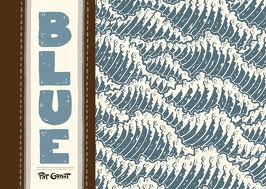
Pat Grant's Blue is possibly one of the most intelligent deconstruction of Australian identity and latent bogan racism ever written. It's also a very good comic book that's well produced and drawn instead of being a narrative with a graphic novel tacked onto it. The story of young kids adjusting to adulthood as times change around their fictional isolated country beach town while immigration of blue people from an unnamed nation sets tensions between cultures to a boil explores the uncomfortable and weird subtext of racism in Australia that seems odd because these people are fighting for a way of life that wasn't very culturally enriched to begin with. They fear losing their precious meat pies and sausage rolls while disparaging newly introduced cuisine to their local area that's made by immigrants that don't speak their language, but it's left unsaid whether the noodles in a bowl they make is better than what the yobs had before. In the final panel of Blue the central bogan character is seen eating one of these bowls even as he literally whitewashes the blue alien graffiti off a wall, which is re-claimed by a passing by blue person as he abandons his post. The graphic novel before us could be misinterpreted as a right wing screed against immigration but the author states in the end notes he's not a right wing crank at all, and given Shaun Tan took a look at this thing before he was willing to publish it says a lot about where this Pat Grant guy's intentions lie. He's so successfully captured the mindset of a bogan racist within a fictional universe with blue alien people that he could be mistaken for a racist himself.

But in the endnotes, Genealogy Of The Boofhead: Images, Memory And Australian Surf Comics, included in the back of the graphic novel, Pat Grant's true genius as historian as well as cartoonist emerges.

I knew I wanted to write about localism, racism and the creepy politics that play out in small town supermarkets and surf club car parks, but the ideas I came up with didn't work until I combined them with the story of some spotty kids who walk up the line to see some human wreckage. - Pat Grant
 Yet the disturbing undertones of Australia as a culture of bogans isn't fully appreciated with the text of the Blue graphic novel alone until the themes of this work are further elaborated on in the endnotes:

Today's 12-year-old will never understand what it was like growing up in an isolated Australian coastal town in the 90s. The nearest comic book store was six hours' drive from my home. The internet was five years late and another five had to pass before it was fast enough to be useful. The media we had access to on the north coast of New South Wales was as bland and lacking in sustenance as the white bread in our lunchboxes. To add to this, Australia does not have a wealth of comic art history. In fact, this country has a bad record when it comes to any kind of history. Our way of writing history is to destroy old things pertinent to our landscape and experience, and to import readymade mythologies from overseas. There's not a lot of comic art floating around Australia, in the way that there is in the US, nor is there a culture of collecting it. If we had a silver or golden age of comics, it's unknown to me. And while there are attempts at a publishing industry like that in the States, a truly Australian comics culture has been something of a chimera. That's not to say there weren't or aren't amazing artists or devoted fans, but when it seems you're on the rock farthest from the bright center of the comic-book universe, Tatooine syndrome tends to prevail. Success on the sandy planet isn't much success at all, and there's always another womp rat in a Southern Cross singlet looking to tear you down. - Pat Grant
There is so much in that singular statement that expresses so much of the older, Generation X mentality towards Australian culture that says more than I ever could about how the Australian creative character feels stunted, and no matter how much you wish to create something beautiful and thoughtful  some yob in a Southern Cross singlet will kick down the elaborate and wondrous castle you have built on the sand. The beginning sequence of panels where a newcomer to the beach inquires what his peers are up to, explaining he's from Sydney and he's come to visit the beach. But when the locals who have built what they declare is not a sand castle, but a keep, grow bored with their own creation, they kick down the object of their creativity, leaving the newcomer to gaze upon the ruin of something that he showed interest in. The symbolism of these sequential images is palpable given the above statement, which I haven't entirely finished unpacking. Perhaps Pat Grant is implying that the Australian culture has been neglected and destroyed once the yobs who made it popular are bored with it, and furthermore his statement seems to imply that any Australian attempt at creating any kind of art that wants to compete on a world scale with imported works has to cope with the looming boofheads who will tear down any attempt to create a civilised world in the Land Down Under.

Pat Grant is entirely correct in one assumption. The isolation of a pre-internet Australia will never again exist for my generation and the ones coming after it. Where Pat Grant's generation must have seen apathy, cynicism and painful resignation to the lack of change and caring about our own history, I've seen slowly disappearing, if a bit gradually from the ranks of my own peers. The best and brightest of my peers I hang around with aren't going to risk trusting their future with the yobs who would tear down everything beautiful. There is a deep distrust of politicians currently with people my age, however it is not a cynicism rooted in the idea that nothing will ever change. It's the idea that we know how to run the country better than the boofheads in Parliament, and because we have no Bill Of Rights to call our own because of our archaic Constitution written in a time when Aboriginal and Torres Strait Islander people were considered subhuman and terra nullis was the order of the day, we feel completely powerless to change anything until we can finally take the reigns for ourselves.

The awkward embarrassment young people with intelligent minds feel about Australia isn't just the racism or the misogyny and the lack of a true established culture we haven't imported from elsewhere, it's the result of several generations of Australians living under the dinosaur era isolation mentality that refuses to die in spite of the internet. We feel like our politicians have to die off before the threats to our sanity and our reason expressed to the decaying wreck of bogan rule before anything good or beautiful can exist here. We care little for our history because we're screaming for a future where intelligence is valued and art can prosper to arrive.

Tuesday, February 26, 2013

The Guardian Of Outdated Australian Stereotypes

I haven't blogged for about a week, but today I saw something in the Guardian.co.uk online news section for Australia where I was forced to comment via my corner of the web.

First some context, the Australia section of The Guardian's online newspaper site was recently opened up to provide more credible journalism than the mainstream news sources Australia has which have gone to the dogs, but articles like this just fill me with dread as to the accuracy of the picture this well meaning newspaper section is painting about my country.

Some of the commentary is dead on, a lot of racism and sexism is still around, the Aborigines are treated even worse, and nobody seems to be doing anything about it. At least it seems that way. To say Australians don't like change is somewhat misleading. They don't like bad change, is a more apt description of what we like or don't like about this country. Change is slow down here, but it's happening more rapidly than most people who don't have the internet probably realise. We live in an age where the average twenty something in Australia knows more about the internet than the government figures supposedly meant to represent them and govern how everything is to be run.

This is notable in that a recent case where customs confiscated manga that a local Australian collector imported ended with the customs agency forced to return the manga/smut/erotica/art (which warms my heart, don't get me wrong, I relish every second of embarrassment the moral guardians in this country have dished out to them) to the person who ordered this stuff online. Oh, we have culture, we might have to import it sometimes but it's there.

We also have a culture, a time honoured tradition, of bringing embarrassment to politicians and moral guardians who question our way of life, for good or ill. Sure, we get situations where hate speech is played on the radio, but we also get situations where the attempts for a national internet filter were so poorly put together by overly nanny state-ish OFLC and telecommunications boards that it was defeated with much applause from the nerds of this country, whose tireless efforts to keep the Prime Minister's mitts out of our personal lives is in need of some kind of medal, considering how many flame wars our local internet has had to go through to remain uncensored like a lot of our movies and video games have been in the past fifty years.

Because of the incompetent attempts to nanny state the people too young to care about what the old stick in the muds of censorship have to say about us, and too old to be bothered fighting these annoyances directly rather than just ordering things online from overseas when nobody's looking, that right there is the Australian character, writ large.

We do have a culture, it's not built in stone or cement as much as it's built upon years of fighting in silence until now against irrelevant cultural dinosaurs that need to go extinct. There are people who are changing things in this country, they're just not as loud as the rugby and soccer fans drunk on Victoria Bitter about it.

Saturday, February 23, 2013

Men, Feminism and Boneheading

Recent internet drama has come to light, and once again we come across the problem of men "mansplaining" and women not being listened to, possibly because the men who think they don't have a solution to these problems don't generally throw their hat into the ring with these discussions like idiots such as the "Amazing Atheist" seem to. People who genuinely believe they have no real solution to problems, no matter what their gender, race or creed is, tend to shut up because they don't think they can offer anything to a heated situation that adds real value.

Mansplaining is an odd word, it condemns men rightfully for trying to justify their privilege, yet it is such a prohibitive word that shuts down any, even legitimate solutions to problems men might offer. I propose a new word replace mansplaining, or rather, an old one that has stood the test of time against generations of foolhardy men and women sticking their nose into a complicated situation they have no idea how to solve.

Enter boneheading. Now, I'm assuming not a lot of you have seen a Jean Claude Van Damme movie, but for those who have, from Bloodsport, Cyborg, Knock Off, even Universal Soldier: The Return, there's usually this annoying, poorly thought out and badly written female love interest that gets shoehorned into the plot because either the studio or the screenwriter believed they needed this element in an otherwise serviceable action movie featuring partial martial arts choreography. The female love interest keeps doubting the Jean Claude Van Damme-played protagonist, and adds nothing to the story apart from this emotional brick wall that gets in the way. It's neither a method of writing a good action movie, nor is it a particularly flattering portrayal of women in life or death situations.

And I believe that men can bonehead just as badly as these Jean Claude Van Damme action movie love interests tend to do. Donnie from The Big Lebowski comes to mind in more well meaning cases, described as "like a child who wanders into the middle of a movie" with no understanding of the crisis at hand. Donnie here represents a more naive, well meaning boneheading situation, he's not written hatefully like the Jean Claude Van Damme action movie love interests are, but he certainly is annoying to the other two main male protagonists of the plot. There's no malice there, but there's a sense that he doesn't quite understand why his two friends are stressed out over the matter of a rug.

More negative examples of male boneheading in cinema come from the duology masterwork that is both Breakin' and Breakin' 2: Electric Boogaloo. These movies are an interesting case because not only is the protagonist a woman who is constantly hassled by the boneheading, and the sheer not knowing of the old white men whom her background comes from, who dismiss the worth of the street dancers and the urban positive expression they bring to the black community in their artform not tied to the white establishment of Broadway and studio dancing. But in her own boneheading, she doesn't quite understand why Shabadoo is very hesitant to even bother trying out for a white dance competition when he is quite happy expressing himself on the streets where black males like himself are granted some level of dignity and respect. These two movies are very good at both dance sequences and introducing young students of sociology to how subculture and race intermingle, and also issues of belonging in ethnically diverse communities and culture clash with more ethnically white establishments like Broadway which is mainstream, along with other parts of the entertainment industry.

I'm telling the world, right now, that we need to move beyond mansplaining, for boneheading is a condition of ignorance that knows no gender, race or creed, and that everybody on Earth for just a moment can look like a damn fool when they walk into a heated discussion not knowing what they're talking about.